Built around real class material

Your notes do not stay in one format. Your study workflow can.

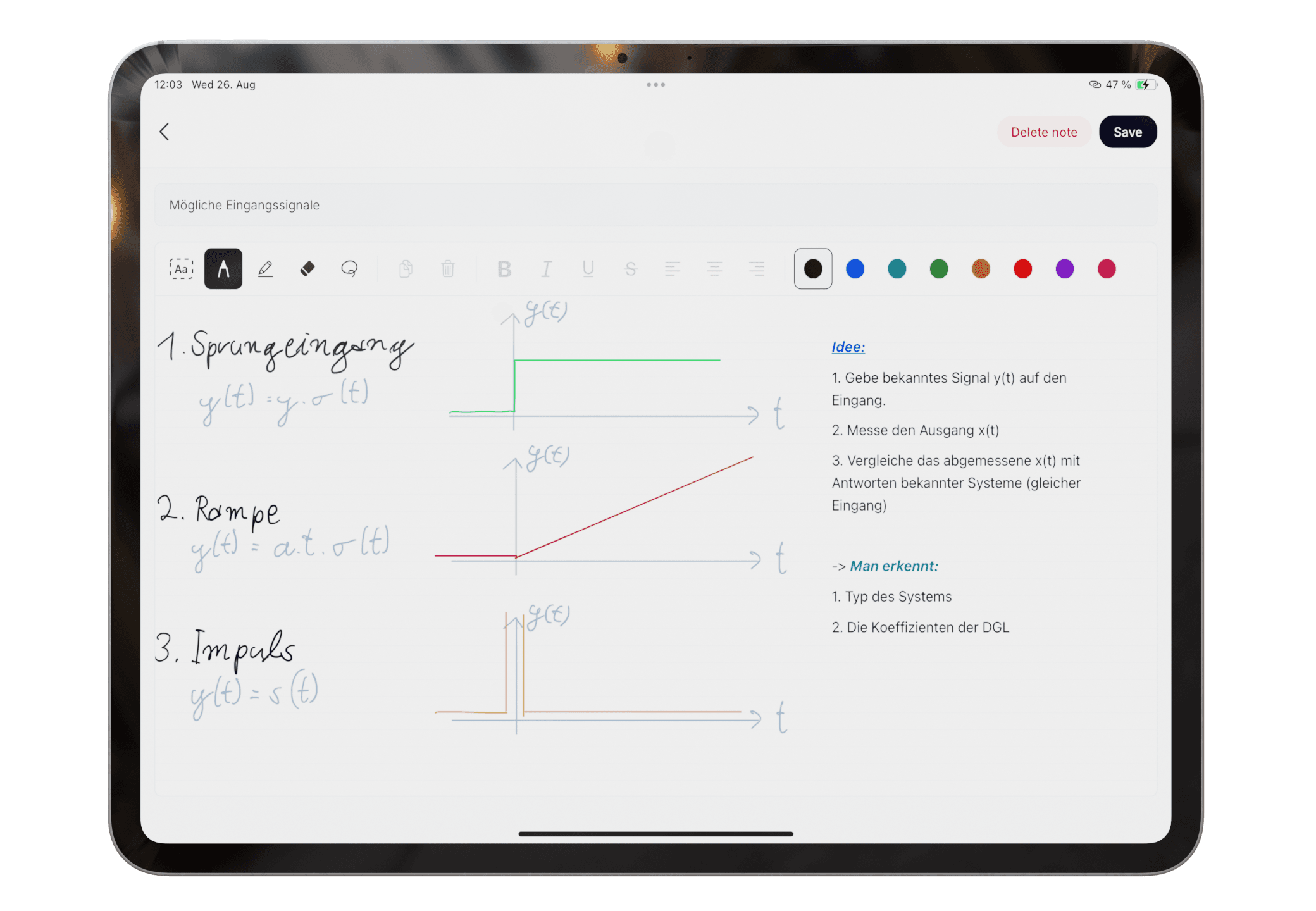
Type precise details, scan the paper already in front of you, or draw naturally with Apple Pencil. Pocket Orbit helps turn those mixed inputs into material you can find and review later.

Best for

  • + Students switching between keyboard, paper, and Apple Pencil
  • + Fast capture followed by lightweight organization
  • + Study summaries that remain connected to source notes

Not designed for

  • - Deep PDF annotation
  • - Automatic lecture recording
  • - Professional drawing or database-heavy workspaces

The real problem

Class material changes format before you can build a perfect system

Messy material is normal. The friction starts when the app expects every thought, worksheet, and diagram to behave the same way.

01

Typing can be too rigid

It is precise, but formulas, arrows, and spatial ideas can become slower to capture.

02

Paper gets disconnected

The page still exists, but it is separated from the typed context and summary you need later.

03

Digital notes still scatter

A fast inbox becomes another maintenance job when every note needs a folder decision first.

One capture system

Choose the input that fits the moment

You do not need to commit to one note-taking identity. Switch modes as the class changes.

Capture exact wording

Use the keyboard for definitions, structured explanations, and details where precision matters.

See exact steps
Typed notes organized in Pocket Orbit

When you need the note later

Spend the next study session understanding, not rebuilding

01

Find related notes

Review suggested groups instead of maintaining a complex workspace before every capture.

02

Study a shorter version

Generate a summary after checking the source and recognition for important details.

03

Keep control

Correct organization and recognition when the context is ambiguous rather than trusting automation blindly.

Trust before claims

Know what was checked and where the boundaries are

Product review2026-07-29
Testing standardRead methodology
Current boundariesBest for / not for below
Support proofOpen help center
Questions

Frequently asked questions

Is Pocket Orbit only for handwritten notes?

No. Type, Scan, and Draw are equal input modes, so the best mode can change within one class.

Does Pocket Orbit replace every student notes app?

No. It prioritizes mixed-input capture, organization, and summaries. A PDF-heavy notebook or audio-first app may fit other workflows better.

Editorial trust

Sources, method, and update policy

Product claims are checked against the current app. Competitor claims use dated official sources. Corrections can be sent to alpaca-labs.dev@proton.me.

Keep going

feature

Apple Pencil Note-Taking App for Handwritten Notes

Handwrite notes on iPad with Apple Pencil, then review, recognize, organize, study, or export them in Pocket Orbit.

Read feature

feature

Scan Handwritten Notes to Text on iPad

Capture paper notes, review OCR text, organize related material, and create a study summary with Pocket Orbit.

Read feature

feature

Automatic Note Organization for Messy Class Notes

Turn mixed class notes into suggested groups and summaries without building a complex folder system first.

Read feature

feature

AI Note Taking on iPad for Student Workflows

Capture class notes by typing, scanning, or drawing, then use AI to organize and summarize them in Pocket Orbit.

Read feature

hub

Handwritten Notes on iPad: Workflows, Tests, and Guides

Learn when to type, scan, or draw notes on iPad and how to turn mixed inputs into organized study material.

Read hub

comparison

Pocket Orbit vs Goodnotes for Student Notes

A use-case comparison of mixed-input capture and AI organization in Pocket Orbit versus the notebook and PDF depth of Goodnotes.

Read comparison

Try the Type, Scan, and Draw workflow

Download Pocket Orbit from the App Store, then use the linked help articles to test it with your own notes.

Download Pocket Orbit on the App Store